

-
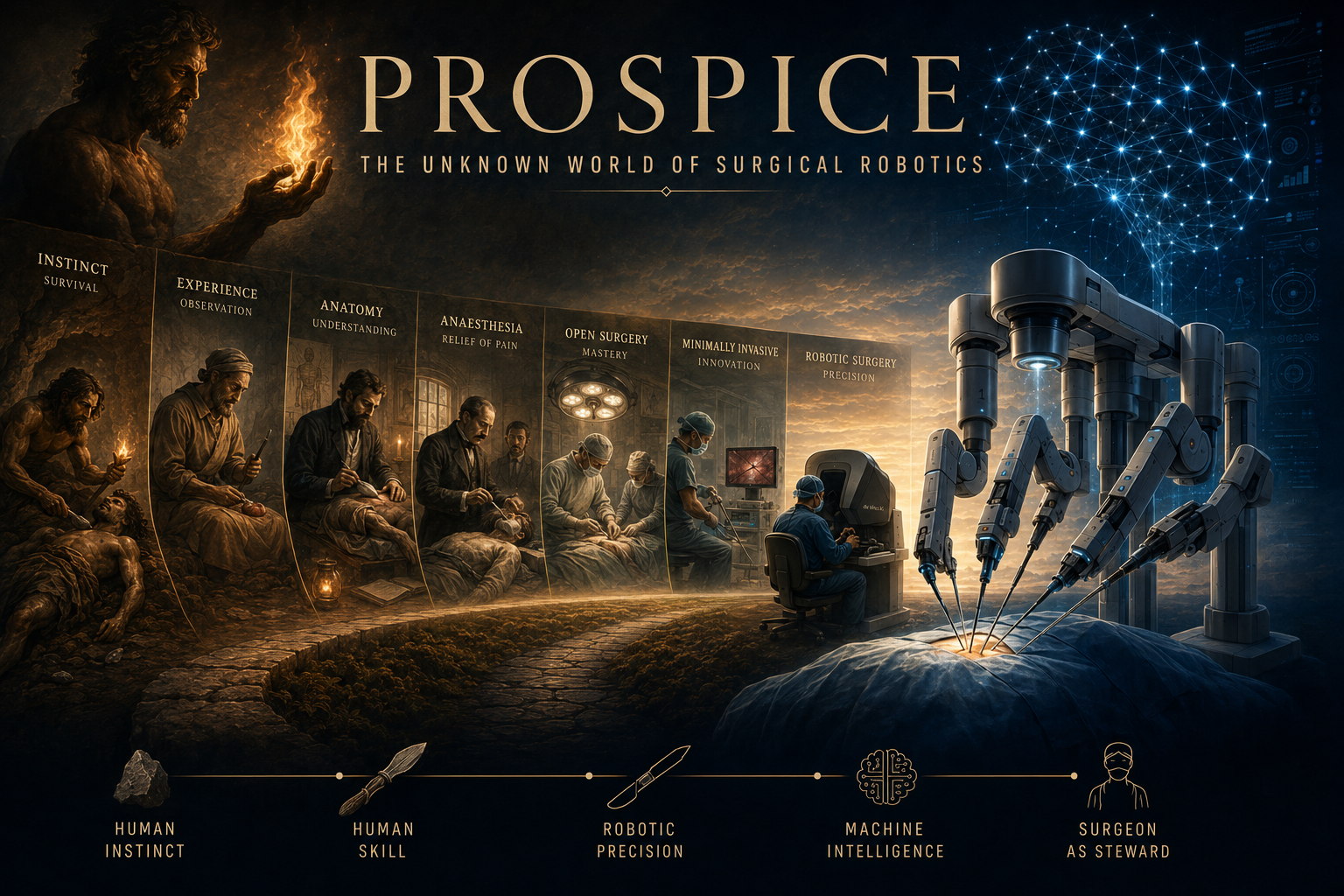
There's an old word in English. Almost forgotten now. Prospice.
It comes from Latin, and it means, simply — look forward. Not a hope. Not a wish. An instruction. The poet Robert Browning used it as a title, in a poem about facing the unknown without flinching. Meeting whatever comes — and with a stride.
I keep it in mind, because it says something about where surgery stands today. We're at the edge of a change we don't yet fully understand. And the only honest thing to do — is to look forward at it. Clearly. Neither dazzled by the promise, nor blind to the risk.
Let me start with the instrument we already have. Robotic surgery, as most patients meet it, is a remarkable thing — but a modest one. The surgeon sits at a console, a few feet from the patient, and moves the controls. The robot's arms turn those movements into fine, steady motion inside the body. No tremor. Sub-millimetre accuracy. But here's what matters. The robot doesn't decide anything. Every motion begins in the surgeon's hand. The machine simply — obeys.
In an earlier piece, I described the value of that instrument through three P's. Precision. Performance. Perfection.
Precision — the steadier hand, working safely around vessels, nerves, the wall of the bowel.
Performance — consistency, case after case. Not one good operation. Reliably good ones.
And Perfection — refinement. Technique sharpening with every procedure.
But notice what all three have in common. Each of them is really a description of the surgeon — getting better. The judgement, the decision — all of it still lives in the person at the console. The three P's perfect the surgeon. They don't change what surgery is. And that is the assumption now being questioned.
A recent review in Science Robotics asks it plainly: will your next surgeon be a robot? Its argument is uncomfortable, but fair. The quality of an operation is still limited by the surgeon performing it. Their skill. Their experience. Even their performance on a given day. Consider colon cancer. Diagnosed in more than a hundred and fifty thousand people a year, in the United States alone. Surgery is the cure. And yet, in some studies, complications reach as high as one in four — largely because surgeons differ in skill and technique. Here's the sobering part. Even robotic surgery — for all its precision — hasn't clearly reduced the most feared complications. So the reasoning goes: if a better instrument, in a skilled hand, hasn't solved this — perhaps the next gain doesn't come from a better instrument at all. Perhaps it comes from reducing our dependence on the hand itself. And this is no longer science fiction. In 2022, an autonomous system at Johns Hopkins performed a procedure on a living subject — largely on its own. Slower than a human. But the results were comparable. By 2025, a newer version could place nearly six stitches in a row, without the surgeon touching the needle. The way it learns echoes how we train self-driving cars. It studies tens of thousands of recorded operations — matching what the camera sees, to the movements expert surgeons make in response.But the caveats matter just as much as the headline.
Autonomy with AI will arrive slowly, and unevenly. The first cases will be the predictable ones. The difficult patients — those with scarring from previous surgery, where the anatomy is distorted — will stay in human hands for a long time yet. The regulation is unsettled. The question of who is responsible — unanswered. And at every stage so far, it is the experienced surgeon who still carries the outcome. We are, at most, on the lowest rungs of a very long ladder. And so — we come back to Prospice.To looking forward. Honestly. At what this becomes. There's a figure from the old stories worth holding here. Prometheus — who stole fire from the gods, and gave it to humankind. It's the perfect image. Because it holds two truths at once. The fire was a gift — a power once beyond our reach, now placed in human hands. Changing what was possible, forever. But it was also a burden. Prometheus wasn't celebrated for it. He was made to answer for it. And that is exactly right for what's coming.
Autonomous surgery with AI is a real gift. The possibility that expert care need not depend on which surgeon happens to be in the room. That consistency might rise beyond what any single pair of hands can promise. That skilled surgery might one day reach the places medicine struggles to go — the remote clinic, the underserved town. Perhaps, one day, beyond the Earth itself.
That is fire worth taking. But like all fire — it must be carried with care. The responsibility doesn't disappear because a machine performs the motion. It deepens. The surgeon doesn't vanish. The surgeon moves upward — from the one who executes, to the one who guides, and judges, and answers for what is done.
The first three P's perfected the surgeon. The fourth is different in kind. Prospice is not another virtue to master. It is a direction — to face. It asks us to look forward. At a surgery that is beginning to change, not in degree — but in nature. From an instrument the surgeon controls — toward an intelligence the surgeon guides. And to walk toward that horizon clear-eyed. Unafraid. And fully aware of the weight of the fire we are being handed.
Look forward. The unknown world is already taking shape. And the first thing waiting there is not a machine. It is a question. Who is responsible?Courtesy: This piece was conceptulazised by Dr Manjunath and edited and written with AI where necessary . It has been scripted for correctness and propreity.
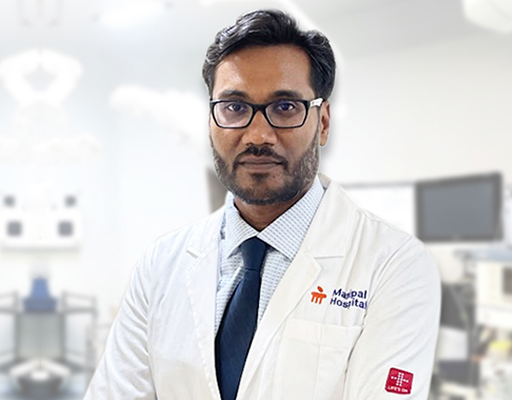
Author: DR. MANJUNATH HARIDAS (MD FACS FICS)
Dr. Manjunath Haridas is one of the leading surgeons for Gastrointestinal Sciences in Whitefield, Bangalore. His area of expertise includes Gastrointestinal Surgery - Colon Rectum, Foregut Advanced Laparoscopic Surgery, and Minimally invasive surgery. He is Honored by the American Board of Certification, fellow Of the American College of Surgeons, SAGES membership and more.